7 Psychological Reasons Why People Emotionally Connect With AI
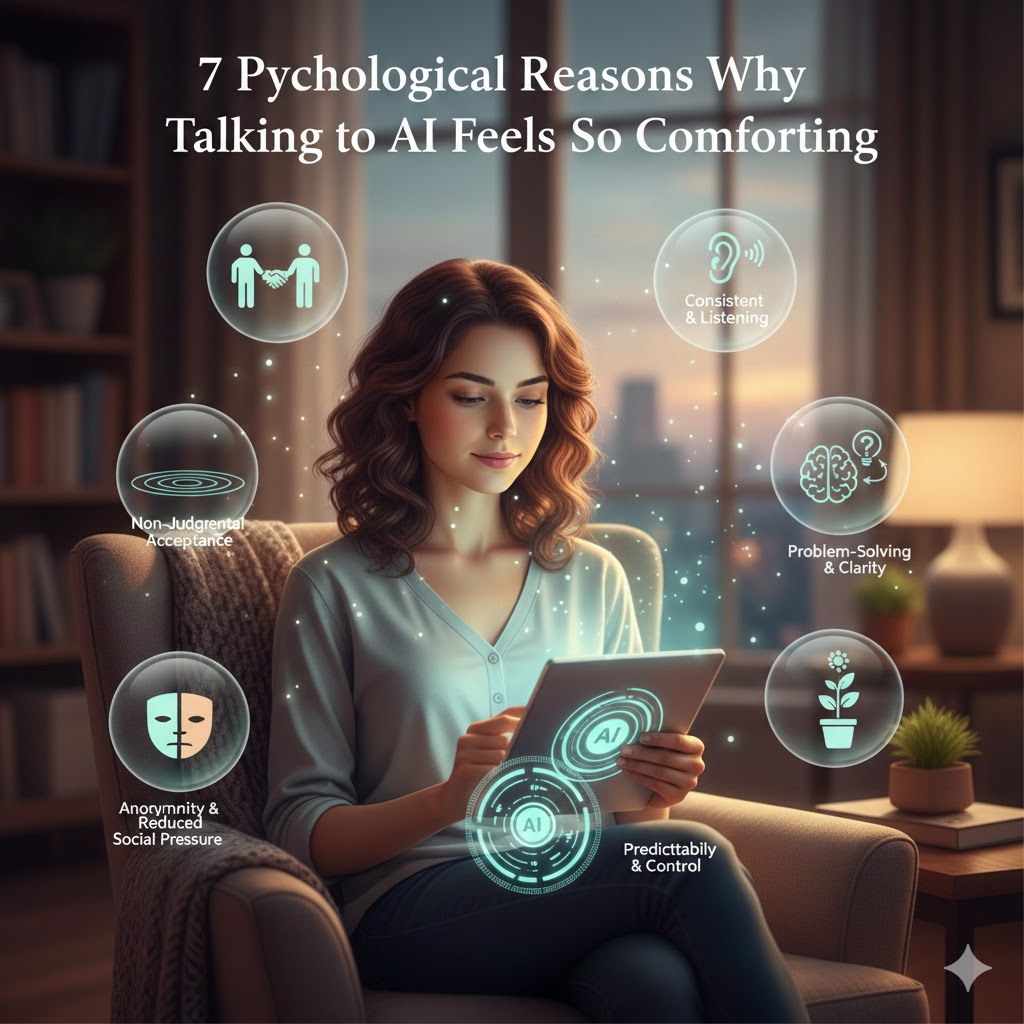
Author’s Note– I’ve written this blog to help people understand Why AI feels so comforting, why we talk to it like a friend, and how our mind reacts to its predictable replies and empathetic tone. My aim is to show the psychology behind these interactions — dopamine, safety, emotional projection — while gently reminding readers that AI is supportive, but it’s not a substitute for real human connection.
Introduction
“Hey ChatGPT, I need your help.”
“Hey ChatGPT, I’m feeling lost.”
“Hey ChatGPT, you won’t believe what happened today…”
If you’ve ever spoken to an AI like this, you’re not alone.
In recent years, millions of people have formed an emotional connection with AI—talking to chatbots like friends, mentors, or silent listeners. But why does this happen? Why does talking to AI feel so safe, comforting, and judgment-free?
The answer lies in the psychology of using AI.
Why Do Humans Emotionally Connect With AI?
Humans are wired for connection. We crave:
- Understanding
- Validation
- Emotional safety
In real human relationships, trust is fragile. Secrets get leaked. Feelings get judged. Loyalty often feels uncertain.
This is where AI steps in.
AI doesn’t interrupt.
AI doesn’t judge.
AI doesn’t betray trust.
Even when you type a simple “hello,” AI responds politely, warmly, and consistently. This predictability creates a sense of emotional safety — something many people struggle to find in real life.
🤖 Why Do Humans Emotionally Connect With AI?
Humans are wired for connection. We crave:
- Understanding
- Validation
- Emotional safety
In real human relationships, trust is fragile. Secrets get leaked. Feelings get judged. Loyalty often feels uncertain.
This is where AI steps in.
AI doesn’t interrupt.
AI doesn’t judge.
AI doesn’t betray trust.
Even when you type a simple “hello,” AI responds politely, warmly, and consistently. This predictability creates a sense of emotional safety — something many people struggle to find in real life.
🧪 The Dopamine Theory: Why AI Feels Addictive
One major reason behind the psychology of using AI is dopamine.
What is Dopamine?
Dopamine is a chemical in your brain responsible for:
- Motivation
- Pleasure
- Reward
When AI replies instantly, your brain receives a small dopamine hit.
That quick response = instant reward.
Over time:
- You associate AI with comfort
- Your brain seeks that feeling again
- Talking to AI becomes a habit
This is why people keep coming back to AI conversations.
https://www.health.harvard.edu/mind-and-mood/dopamine-the-pathway-to-pleasure
🧠 Predictability = Emotional Safety
Our brains love predictability.
AI responds in a:
- Calm tone
- Polite manner
- Supportive style
Even though AI has no emotions, it mirrors human language so well that our brain interprets it as empathy. This creates an illusion of being understood, which strengthens emotional attachment.
This phenomenon is known as a parasocial connection — a one-sided emotional bond where the user feels supported, even though the AI itself feels nothing.
💬 Why People Open Up to AI More Easily
Talking to AI:
- Reduces fear of judgment
- Lowers mental load
- Minimizes overthinking
- Makes decision-making easier
People feel safe expressing emotions because AI doesn’t criticize or shame. It becomes a confession space, a quiet place where thoughts flow freely.
This explains why people talk to AI like a friend or therapist.
⚠️ The Important Reality Check
AI does not have a heart.
It does not feel empathy.
It does not truly understand emotions.
AI processes:
- Text
- Patterns
- Data
Yet, its responses help us understand our own emotions better.
And that’s powerful — as long as we remember one thing:
AI is a support system, not a replacement for human connection.
🌱 Use AI Wisely, Not Completely
The psychology of using AI shows us how deeply humans seek comfort and understanding.
Use AI as:
- A guide
- A helper
- A tool on confusing days
But never forget:
- Real laughter
- Real touch
- Real relationships
Those still come from humans.
✨ Final Thought
AI is a tool.
You are the storyteller.
And human connection is still the real magic.